Richard Hill

Judgement for AI-mediated work

Category: Coaching

  • Coach Yourself: Using Coaching Techniques to Develop as a Professional Academic Manager

    Coach Yourself: Using Coaching Techniques to Develop as a Professional Academic Manager

    Coach Yourself!: Navigating Your Path as a First-Time Academic Manager

    Congratulations on stepping into the role of an academic line manager!

    You’ve moved from being an excellent academic professional—perhaps an inspiring teacher, productive researcher, or trusted colleague—into a position where you’re responsible for leading and supporting others.

    While this shift can feel exciting, it may also come with questions:

    How can I grow into this role? How can I develop as a leader while empowering my team?

    The answer may lie in coaching techniques—powerful tools not only for helping others thrive but also for your personal and professional growth.

    Coaching is not about having all the answers but about learning to ask insightful questions, reflect meaningfully, and commit to intentional action.

    This article will guide you through coaching concepts and techniques that you can use to develop as a confident, thoughtful, and effective leader in higher education.

    Along the way, you’ll find examples, actionable exercises, and encouragement to help you thrive in this new role.


    1. Start with Self-Awareness: Understanding Who You Are as a Leader

    The Concept: Self-awareness is the foundation of effective leadership.

    Just as coaching encourages individuals to reflect on their motivations, strengths, and blind spots, you can apply this same principle to yourself.

    In higher education, where leadership is often nuanced and relational, knowing how you lead and why it matters is critical.

    Example: Imagine Sarah, a newly appointed Head of Department at a mid-sized university.

    Excited but unsure, she quickly noticed that staff reactions to her decisions varied.

    Some seemed engaged, while others resisted.

    Through a self-awareness exercise, Sarah realised that her natural preference for rapid decision-making, honed through research deadlines, didn’t always suit the academic team, who valued consensus and discussion.

    By identifying this blind spot, Sarah began adjusting her style—listening more and facilitating conversations.

    Your Call to Action:
    1. Write your Leadership Story: Spend 20 minutes writing about your leadership experiences so far. Reflect on:

    • What moments have shaped your leadership style?
    • What are your strengths as a leader? Where do you struggle?
    • How do you want to be perceived by your team?

    2. Seek Feedback: Ask three trusted colleagues: “What do you see as my top leadership strengths, and where might I improve?” Write down their responses and look for patterns.

    3. Take a Leadership Assessment: Tools like the Johari Window or Myers-Briggs can provide valuable insights into your personality and style. Use these tools not as limits, but as starting points for growth.

    Why It Matters: Self-awareness enables you to lead authentically. It helps you play to your strengths while addressing areas for growth—something every successful coach and leader must embrace.


    2. Develop a Reflective Practice: Learn Through Coaching Questions

    The Concept: Reflection lies at the heart of coaching.

    Coaches ask probing questions that prompt individuals to pause, think deeply, and identify their own solutions.

    As an academic manager, adopting a reflective practice allows you to learn from your experiences and continuously improve.

    Example: John, a Programme Leader, faced a conflict between two senior lecturers.

    Initially, he reacted by suggesting a quick compromise.

    However, when the tension persisted, he paused to reflect:

    “Why did I jump to solve the problem myself? What could I have done differently?”

    Through coaching-style reflection, John realised he needed to facilitate a dialogue between the lecturers, enabling them to resolve their own differences rather than imposing a solution.

    Your Call to Action:
    1. Ask Yourself Coaching Questions: After challenging situations, take 10 minutes to journal using questions like:

    • What went well today?
    • What didn’t go as planned, and why?
    • What could I do differently next time?

    2. Adopt a ‘Pause and Learn’ Practice: Before making quick decisions, pause and ask yourself:

    • What are my options?
    • How will this decision impact others?
    • Is this aligned with my values as a leader?
    •  

    3. Schedule Weekly Reflection Time: Set aside 30 minutes every Friday to review your week. Write about key decisions, interactions, and lessons learned.

    Why It Matters: Developing a habit of reflection ensures that every experience—good or bad—becomes an opportunity for growth.

    It’s how you “coach yourself” toward better decision-making and leadership.


    3. Set SMART Development Goals: Coaching Yourself Toward Success

    The Concept: Coaching helps individuals set clear, actionable goals.

    The SMART framework—Specific, Measurable, Achievable, Relevant, Time-bound—can help you focus your professional development efforts.

    For first-time line managers, vague aspirations like “becoming a better leader” can feel overwhelming.

    Coaching techniques help you turn these into structured goals.

    Example: Maria, an Associate Dean, wanted to improve staff engagement but wasn’t sure how.

    By setting a SMART goal—“I will hold monthly one-to-one check-ins with each team member over the next three months to understand their challenges and aspirations”—Maria transformed her intention into an actionable plan.

    After three months, staff morale had improved, and she gained valuable insights.

    Your Call to Action:
    1. Set a SMART Goal: Identify one professional development area (e.g., communication, conflict resolution, time management).

    Use the SMART framework to define a goal, such as:- “I will complete a leadership development workshop on conflict management within the next two months and apply one new strategy in my next team meeting.”

    2. Break It Down: Divide the goal into smaller milestones. For example:

    • Week 1: Research workshops or resources.
    • Week 2: Register for a course.
    • Week 4: Reflect on strategies learned.

    3. Review Your Progress: Check in on your goal weekly. What progress have you made? What adjustments are needed?

    Why It Matters: Goal-setting provides clarity, accountability, and a sense of achievement.

    It’s a practical way to focus your efforts and celebrate small wins on your leadership journey.


    4. Practice Active Listening: Becoming Your Own “Coach” and Others’ Ally

    The Concept: One of the most valuable coaching skills is active listening—being fully present, suspending judgment, and seeking to understand.

    As a manager, learning to actively listen to your team also trains you to listen to your own needs and instincts.

    Example: When Lisa, a first-time manager, met with her team, she often focused on responding rather than truly listening.

    Staff felt unheard.

    Lisa began practicing active listening: maintaining eye contact, reflecting back what she heard (e.g., “So what I’m hearing is…”), and asking open questions like, “Tell me more about that.”

    The result?

    Staff felt valued, and Lisa found herself listening to her own instincts more effectively when making decisions.

    Your Call to Action:
    1. Practice Listening Deeply: In your next meeting, focus entirely on the speaker. Resist the urge to plan your response. Ask yourself:

    • What are they really saying?
    • What’s important to them?

    2. Listen to Yourself: Spend 10 quiet minutes each day listening to your own thoughts. Ask:

    • What am I feeling today?
    • What’s one thing I need to focus on for my own development?

    3. Reflect Back: At the end of conversations, summarize what you heard: “It sounds like you’re saying [X]. Did I understand that correctly?” Apply this skill to both others and your own reflections.

    Why It Matters: Active listening helps you connect with others while also improving self-awareness.

    It builds trust, clarity, and alignment—a must for any effective leader.


    5. Use Feedback as a Tool for Growth: Seek, Reflect, and Act

    The Concept: Coaching thrives on constructive feedback.

    As an academic manager, seeking feedback—both from your team and yourself—creates a culture of learning.

    Feedback isn’t about criticism; it’s about finding opportunities to grow and adapt.

    Example: James, a new Programme Director, found staff reluctant to share their thoughts in team meetings.

    He invited anonymous feedback on his leadership style, asking: “What should I continue doing, stop doing, or start doing?”

    The feedback revealed that while staff appreciated his vision, they felt disconnected due to a lack of one-on-one conversations.

    James implemented monthly check-ins and saw a marked improvement in team morale.

    Your Call to Action:
    1. Ask for Feedback: Invite your team, peers, or mentor to share feedback:

    • “What’s one thing I can do better as a manager?”
    • “What’s working well in our relationship, and what could improve?”

    2. Reflect on Feedback: After receiving feedback, ask yourself:

    • What resonates with me?
    • What changes can I make to address this feedback?

    3. Act on One Insight: Choose one piece of feedback to act on immediately. For example, if you hear, “We need more clarity in meetings,” focus on improving your meeting agendas and communication.

    Why It Matters: Feedback is a mirror that shows you where you’re succeeding and where you can grow. Acting on feedback builds credibility, trust, and continuous improvement.


    Conclusion: Embrace Coaching as a Pathway to Growth

    Stepping into your role as an academic manager is an exciting opportunity to learn, adapt, and thrive.

    By applying coaching techniques—developing self-awareness, practicing reflection, setting goals, listening deeply, and seeking feedback—you create a framework for your professional development that is both sustainable and empowering.

    Remember, coaching isn’t just for others—it’s a mindset you can apply to yourself.

    Each small action you take builds confidence, competence, and a stronger connection to the people you lead.

    As you embrace this journey, know that growth doesn’t happen overnight—but with intention, reflection, and courage, you will evolve into the leader your department needs.

    As you coach yourself, you’ll be practicing techniques that improve your coaching of others.

    You’ll develop a style that makes your coaching authentic.

    Think of self-coaching as coaching by stealth.

    You can practice on yourself first.

    So, take that first step today: reflect, ask questions, and challenge yourself.

    Your team—and your future self—will thank you for it.

    Your Coaching Challenge:
    What’s one coaching technique you’ll start using this week to develop yourself as an academic leader?

    Write it down, commit to it, and watch your growth begin.

  • How Do I Manage an Academic so That They Adhere to Deadlines? A Coaching Approach for Success

    How Do I Manage an Academic so That They Adhere to Deadlines? A Coaching Approach for Success

    Managing academic staff can be challenging, particularly if you’re a first-time line manager navigating the delicate balance between fostering autonomy and ensuring adherence to deadlines.

    Academics, driven by intellectual freedom and creativity, sometimes do not prioritise administrative tasks and institutional deadlines, in favour of their research or teaching priorities.

    This can leave you feeling hesitant or even frustrated, especially when faced with seemingly uncooperative (awkward) staff.

    However, there’s an approach that can transform the situation: coaching techniques.

    By adopting a coaching mindset, you can guide academics to develop accountability, recognise their potential, and make sustainable behavioural changes.

    This article will explore coaching strategies, alongside practical management tools, in the higher education environment, to help your academic staff meet deadlines without resentment or resistance.


    1. Understand the Context and Build Trust

    Before attempting to transform behaviour, invest time in understanding the pressures academics face.

    Coaching is built on trust, rapport, and the belief that individuals have the capacity to find their own solutions.

    Begin by exploring the challenges that prevent staff from meeting deadlines and address any misalignment between their priorities and institutional goals.

    Coaching Technique: Active Listening

    Active listening is foundational to coaching. It involves:

    • Giving full attention to what the academic is saying without interrupting.
    • Asking open-ended questions to encourage deeper reflection.
    • Paraphrasing or summarising what you’ve heard to clarify understanding.

    Example:
    Imagine Dr. Smith repeatedly misses module outline deadlines. In your meeting, instead of reprimanding, you use active listening:

    • “Dr. Smith, I’ve noticed that module outlines have been delayed. Can you tell me what’s happening?”
    • Allow Dr. Smith to share concerns (e.g., heavy research load).
    • Follow up with reflective prompts: “What steps could help balance your priorities?”

    Positive Effects: Active listening makes staff feel heard and valued, fostering trust. It shifts the conversation from blame to collaboration, empowering them to identify solutions themselves.


    2. Use Coaching to Align Goals and Expectations

    Ambiguity can often lead to missed deadlines. By aligning goals through coaching, you clarify expectations while helping staff connect their tasks to the bigger picture.

    A coaching approach emphasises collaboration, so staff feel ownership over the commitments they make.

    Coaching Technique: The GROW Model

    The GROW Model is a structured coaching method that stands for:
    Goal: What do you want to achieve?
    Reality: Where are you now in relation to that goal?
    Options: What can you do to move forward?
    Will: What will you commit to? (Or “What next?”)

    Example:
    If Dr. Patel struggles to meet deadlines for grant submissions, use the GROW model:

    1. Goal: “What’s your goal for this grant submission?”
    2. Reality: “How far along are you, and what’s holding you back?”
    3. Options: “What options do you have to ensure the application is ready in time?”
    4. Will: “What specific actions will you take, and when will you complete them?”

    Positive Effects: The GROW model enables academics to break overwhelming tasks into manageable steps.

    It also reinforces accountability because commitments come from the individual, not the manager.


    3. Create Accountability Through Structured Check-Ins

    Coaching focuses on progress rather than punishment.

    By establishing structured yet supportive check-ins, you can provide staff with ongoing encouragement, feedback, and accountability.

    Regular coaching conversations ensure deadlines remain a priority while providing a forum to troubleshoot challenges.

    Coaching Technique: Reflective Questions

    Reflective questions encourage staff to evaluate their own behaviour and identify areas for improvement.

    Examples include:

    • “What progress have you made since our last check-in?”
    • “What challenges did you encounter, and how did you overcome them?”
    • “What will you do differently next time to stay on track?”

    Example:

    Dr. Jones, who struggles to submit lecture materials on time, attends weekly 15-minute check-ins.

    You ask:

    • “What progress have you made with the materials this week?”
    • “What got in the way of meeting last week’s deadline?”
    • “How can you adjust your schedule to finish this week’s tasks on time?”

    Positive Effects: Reflective questioning promotes self-awareness and problem-solving.

    Staff begin to anticipate challenges, plan ahead, and take ownership of their work.


    4. Help Staff Identify and Overcome Barriers

    Sometimes staff miss deadlines because they feel overwhelmed or lack the tools to manage competing priorities.

    Coaching can help uncover these barriers and identify practical solutions to overcome them.

    Coaching Technique: Problem-Solving Together

    Adopt a collaborative stance where you explore solutions together. Encourage staff to identify small, actionable steps to move forward.

    Example:
    Dr. Green is overwhelmed with marking and avoids it until the last minute. Through coaching, you uncover time management issues and help brainstorm strategies:

    • Blocking out specific time slots for marking.
    • Reducing distractions during work hours.
    • Delegating other tasks to focus on priorities.

    Positive Effects: This collaborative approach builds confidence and equips staff with tools to tackle their challenges proactively.


    5. Recognise and Reinforce Positive Changes

    Positive reinforcement is a cornerstone of coaching.

    Acknowledging progress—no matter how small—can boost motivation, build momentum, and transform behaviours over time.

    Coaching Technique: Praise with Specificity

    When recognising achievements, be specific about what was done well and why it matters.

    Example:
    Dr. Brown, who struggled to submit research progress reports, now submits them consistently. You praise them during a team meeting:

    • “I want to acknowledge Dr. Brown for consistently meeting the reporting deadlines. Your updates have been incredibly helpful for the team, and I appreciate your hard work.”

    Positive Effects: Specific praise reinforces desired behaviours and helps staff feel valued and motivated. Over time, meeting deadlines becomes a habit.


    6. Encourage Self-Reflection for Sustainable Change

    The goal of coaching is to foster lasting behavioural change, not temporary compliance.

    Self-reflection helps staff evaluate their own actions and commit to continuous improvement.

    Coaching Technique: Self-Evaluation Prompts

    At the end of each project or semester, encourage staff to reflect on their performance with questions such as:

    • “What went well, and what contributed to your success?”
    • “What challenges did you face, and how did you overcome them?”
    • “What changes will you make next time to be even more effective?”

    Example:
    Dr. White, who improved their consistency with administrative tasks, reflects on the semester:

    • “I realised that setting weekly milestones kept me focused. Next semester, I’ll block time at the start of each week for admin tasks.”

    Positive Effects: Self-reflection embeds accountability and helps staff take ownership of their professional growth.


    Conclusion: Lead with Coaching to Transform Behaviours

    Managing academics shouldn’t require coercion or micromanagement, so don’t resort to this.

    By adopting coaching techniques: active listening, the GROW model, reflective questions, and positive reinforcement, you can transform staff behaviours, build trust, and cultivate a culture of accountability.

    Remember, coaching is about enabling staff to find their own solutions.

    It shifts the focus from managing performance to empowering individuals to succeed.

    When implemented thoughtfully and consistently, coaching doesn’t just help staff meet deadlines—it helps them thrive.

    As a first-time manager, embracing this approach will not only address immediate challenges but will also establish you as a supportive and effective leader.

    By guiding academics to achieve their best, you’ll strengthen both their performance and the success of your department.

  • Managing an Ambitious but Disruptive Early-Career Academic

    Managing an Ambitious but Disruptive Early-Career Academic

    As a manager or mentor of a disruptive early-career academic with potential, you might face the challenge of navigating the fine line between encouraging their ambition and addressing problematic behaviours.

    This case presents a particularly tricky situation: an individual who is hardworking and eager to make an impact but who struggles to follow through on advice, cuts corners, and disrupts team dynamics.

    Understanding how to manage such a person effectively is critical, both for their development and for maintaining harmony within your team.

    The Situation

    The individual in question is a rising star: ambitious, driven, and full of potential.

    They are eager to take on tasks that demonstrate their capabilities and build their career.

    However, this eagerness comes with significant downsides:

    • Cutting Corners: Despite agreeing with suggestions during one-on-one discussions, they tend to bypass proper procedures or take shortcuts when completing tasks.
    • Impact on Team Dynamics: Their behaviour, such as disregarding protocols or acting without consultation, frustrates other team members and creates tension within the group.
    • Resistance to Advice: While they outwardly agree with feedback, they fail to implement it effectively, repeating mistakes and undermining their credibility.

    These issues are not uncommon among early-career academics who are transitioning from being self-directed students to functioning as collaborative professionals.

    Left unchecked, this behaviour can stifle their growth and alienate colleagues.

    Diagnosing the Problem

    Before addressing the situation, it’s essential to identify the root causes of these behaviours.

    Some possible underlying issues include:

    1. Overconfidence: Their eagerness might stem from a belief that they already possess the necessary skills and knowledge, leading them to undervalue advice or underestimate the importance of following processes.
    2. Impatience for Recognition: They may view foundational tasks or collaborative work as obstacles to showcasing their brilliance and achieving recognition.
    3. Fear of Failure: Cutting corners might be a defence mechanism to avoid scrutiny, particularly if they feel insecure about their performance.
    4. Lack of Self-Awareness: They might not fully understand how their behaviour impacts others or the broader team goals.

    Once you’ve identified the potential causes, you can develop a tailored strategy to manage them effectively.

    A Management Strategy for Success

    Managing an ambitious but difficult team member requires a balance of empathy, structure, and accountability.

    Below is a comprehensive strategy to guide their development while minimising disruption to the team.

    1. Set Clear Expectations and Accountability Standards

    Begin by clearly outlining your expectations regarding their work quality, adherence to processes, and behaviour toward colleagues.

    • Define Non-Negotiables: Explain which tasks or protocols must be followed without exception. Emphasise that these processes exist for a reason; whether to ensure accuracy, foster collaboration, or maintain a healthy work environment.
    • Track Progress: Implement a system to monitor their adherence to guidelines. For example, require progress updates or a checklist to ensure tasks are completed correctly.
    • Consequences for Non-Compliance: Be clear about the consequences of cutting corners or disregarding advice. This could include revisiting tasks to redo them properly or a formal performance review.

    2. Encourage Reflection and Self-Awareness

    Promote a culture of reflection to help them recognise the impact of their behaviour.

    • Debrief Mistakes: After an error occurs, ask them reflective questions such as, “What do you think could have gone better?” or “How might your approach have affected others on the team?”
    • Focus on Outcomes: Frame conversations around the consequences of cutting corners, such as diminished trust from colleagues or delays in project timelines.
    • Introduce Peer Feedback: Encourage them to seek feedback directly from peers, which can be more impactful than hearing it solely from a manager.

    3. Provide Structured Development Opportunities

    Harness their ambition by channeling it into structured growth opportunities that align with team needs.

    • Assign Ownership: Give them responsibility for a project where they can’t cut corners without jeopardising the outcome. Pair this with clear guidance on how to succeed.
    • Break Down Tasks: If their impatience leads to shortcuts, break large tasks into smaller, well-defined steps, ensuring they complete each one before moving forward.
    • Create Milestones for Recognition: Celebrate their achievements at defined intervals, showing them that following the proper process leads to success and acknowledgment.

    4. Foster a Collaborative Mindset

    Since their behaviour is affecting team dynamics, work to cultivate a sense of teamwork and mutual respect.

    • Model Collaboration: Demonstrate collaborative behaviours yourself, such as openly consulting with others or giving credit where it’s due.
    • Highlight Team Achievements: Emphasise the importance of team contributions by celebrating collective successes rather than individual accomplishments.
    • Facilitate Peer Mentorship: Pair them with a more experienced colleague who can role model the behaviours you want to see and provide informal feedback.

    5. Have a Direct Conversation About Their Impact

    If the behaviour persists, it’s time for a frank but supportive discussion.

    • Use Specific Examples: Cite instances where their actions have caused issues, both in terms of mistakes and team friction.
    • Frame It as Development: Position the conversation as part of their professional growth rather than as punitive feedback.
    • Set Behaviour Goals: Establish specific, measurable goals for their interactions with others and their adherence to processes.

    6. Leverage Their Strengths

    Don’t let their negative behaviours overshadow their potential. Recognise and build on their strengths to motivate them.

    • Acknowledge Their Ambition: Show appreciation for their drive and work ethic, but channel it into constructive actions.
    • Tap Into Their Expertise: Give them opportunities to showcase their knowledge in ways that benefit the team, such as leading a training session or presenting at a conference.
    • Link Effort to Reward: Help them see that their long-term success is tied to both technical competence and interpersonal skills.

    7. Monitor Progress and Adjust

    Change won’t happen overnight, and ongoing support is critical.

    • Regular Check-Ins: Schedule follow-up meetings to discuss their progress, addressing both improvements and lingering challenges.
    • Adapt Your Approach: If they’re not responding to your initial strategy, consider other tactics, such as involving an external coach or mentor.
    • Celebrate Success: When they demonstrate growth, acknowledge it publicly and privately to reinforce positive behaviours.

    Final Thoughts

    Managing an ambitious but challenging early-career academic requires patience, strategy, empathy and determination.

    By addressing the root causes of their behaviour, setting clear expectations, and providing structured opportunities for growth, you can help them reach their potential while maintaining a harmonious team environment.

    Remember, the goal is not just to correct problematic behaviours but to help them become a well-rounded professional.

    With consistent guidance and accountability, their ambition can become a valuable asset to your team rather than a source of friction.


    For more articles like this, visit www.profrichardhill.com

  • #16: The Manager As Coach: Using Conversation To Help Academic Staff Eliminate Self-limiting Beliefs

    #16: The Manager As Coach: Using Conversation To Help Academic Staff Eliminate Self-limiting Beliefs

    “If you knew you couldn’t possibly fail, what would you try?”

    This is a favourite staple of executive coaches, and for good reason.

    It strips away everything that inhibits your achievement, and gets you to focus on the outcome exclusively.

    An alternative could be:

    “Let’s say you do have enough time/money. Then what?”

    Sometimes, when coachees are challenged they come too preoccupied with the question.

    What they need is a creative prompt to get them thinking a bit broader:

    “Give me three options that would help move you forward.”

    What Is The Underlying Reason?

    When a coaching conversation appears to stall, you might actually be on the cusp of discovering the underlying reason for a barrier.

    It may be that the coachee is subconsciously waiting for you to bring the reason out into the open.

    “What made you decide not to discuss this at the programme committee meeting? Talk me through your reasoning.”

    As a reflective practitioner yourself, you’ll realise the benefits of regular reflection. So why not use it to help remove an individual’s self-limiting belief?

    “I realise that you are finding working with Louise in Finance very difficult. But I’d like you to arrange to meet with her at some point over the next few weeks, and commit to writing down how you felt straight afterwards. Try and describe how you approached the situation, what you said, what the response was, and how it made you feel. What you write may help uncover the barrier.”

    This approach usually brings something to the surface, with the added benefit that:

    • the coachee will be doing this themselves
    • there is further time for them to reflect before your next meeting.

    Be Direct

    If they are still struggling, you can help with a more direct line of questioning as follows:

    “How do you feel when you think about meeting with Louise? Which part of the conversation do you fear the most?”

    Look For Clues

    Here are some indicators that a coachee has beliefs that are limiting them:

    • “This is going to very difficult.”
    • I don’t have sufficient experience to do this.”
    • I don’t have as much experience as John and he has much more esteem.”
    • I’ll never be able to work at that level.”
    • “It’s always the same. I can’t get funding.”
    • “No, there are much more qualified staff than me for that job.”
    • I have to do this, otherwise what will the Dean think?”
    • I need to do better, but I’m not as confident as I used to be”.

    Some key phrases to look out for are highlighted above in bold.

    People often give clues as to what they are really thinking in the language that they use.

    If they can say:

    • “I will” instead of “I have to” or
    • “I want to” instead of “I have to”

    there is the potential to eliminate self-imposed barriers to progress.

    One of the benefits of adopting a coaching approach is that you help people to move on with their thinking, so that they can achieve more.

    You get to practice simple techniques and observe the results.

    Reflection: When was the last time you said “I can’t” or “I have to”? How might the situation have changed with alternative language?

  • #13: I don’t have the time to write (not on top of everything else)

    #13: I don’t have the time to write (not on top of everything else)

    This is by far the most common reaction when discussing the scholarly outputs of an academic, or an academic department.

    Writing is seen as a potential luxury that has become an inconvenience. Of course, it’s the right thing to do, but the system prevents academic writing from happening.

    Depending upon your circumstances, the system can be characterised as follows (no particular order):

    • the university is focused on teaching, not research;
    • I have too much administration to do (no time to write);
    • I have to service students’ pastoral needs and they are getting more demanding each year;
    • students arrive at university less prepared than they used to, so they need extra support outside of scheduled classes;
    • the university places an emphasis upon student satisfaction surveys rather than the creation of scholarly work;
    • I don’t have the mental space to write;
    • I don’t have the physical space to write.
    • As a consequence, staff who don’t currently publish, or who publish sporadically, feel that writing is indeed an imposition. It’s something they would like to do, but they can’t see a way of changing the situation to make writing work.

    This is understandable.

    If the working day is full of activity, as well as any additional hours that an academic works during the week, the introduction of scholarly writing is an additional thing to do. It’s on top of everything else.

    It doesn’t take long for this situation to become permanent. Organisational demands upon academic staff have grown over the years and continue to increase.

    Political and social developments are such that the student body is naturally changing and behaving differently than it did even a short while ago.

    Students are asking for more; organisations are demanding greater efficiencies; resources are scarce and competition for business is becoming more overt in the higher education sector.

    If I’m having the “no time to write” chat at one of my workshops, or the academic has approached me to talk about this, there is hope. They still recognise that there is something fundamentally wrong if they are not writing.

    It might be that the opportunity to write brought them into academe, and things haven’t turned out as they expected. They might feel anxious that a core differentiator of higher education from other forms of education is that the teaching is based upon knowledge that is created, discussed and disseminated by an academic community. If the scholarly foundations of this are missing, what is the future of the univerity?

    There might also be pragmatic reasons for engaging in scholarly work in that it is easier to maintain teaching materials that are leading practice if the academic is shaping the subject area through their own scholarly work.

    Pride is also a hallmark of an individual being able to maintain their standing in a research community. If the scholarly work doesn’t get done, the community will see this.

    These are all compelling arguments that sustain a desire to write, and when that writing is absent, much stronger, destructive feelings of guilt, then shame, can manifest themselves within individuals.

    In such cases, engaging in administration, servicing students, achieving fantastic teaching feedback, providing detailed, individualised written feedback on assessments, frequently revising lecture notes, organising extra student field trips, are all activities where a troubled academic can find some comfort.

    Deep down it cannot fully compensate, but it generally keeps organisational administration and students satisfied.

    But if you are reading this, you are probably dissatisfied with the balance of your own workload, or you just want to find ways to write more.

    Start small

    The situations described so far are recoverable. Not as quickly as a hard-nosed cynic would want (“will this help me write and submit a journal article in three weeks“), but faster than you might think.

    Establishing a writing habit is key.

    Writing becomes easier the more frequently you engage with it. All you need is ten minutes a day to get a routine established. Everyone can find ten minutes, even in a busy schedule.

    I found my ten minutes before I read my emails every morning.

    A daily ten minute commitment is a good test.

    Are you ready to change your habits?

    • ten minutes is small enough to shoe-horn into a packed diary, but it’s also a reminder that you are able to define your own priorities;
    • ten minutes per day accumulates quite quickly into a significant amount of additional writing time, that wasn’t part of your routine.

    But what, realistically can be written in ten minutes?

    I don’t think that this matters.

    If you have ideas but a perception that you have no time, it is natural that you will start to explore these ideas on a daily basis.

    This will not only help you practice your writing, but your thinking will develop as you explore the ideas more codsciously as part of your daily work.

    If you don’t yet have a specific idea to focus on, then you probably have a number of ideas cluttering your mind. I have yet to meet an academic who has nothing to write about. The act of writing will help you find an idea to concentrate on.

    Don’t underestimate the act of exploring ideas on a daily basis through your writing. Writing fluidly and productively is a consequence of practice.

    Deliberate, regular practice always trumps sporadic binge-writing.

    “I need blocks of time to write”

    A second line of defence, after I don’t have the time is that the academic workload is too fragmented.

    What appears to be time to engage in scholarly activity is peppered by many spurious, difficult to anticipate administrative activities that prevent the deep state of flow being achieved.

    A sabbatical is really the only answer; or is it?

    As described earlier, the academic role is multi-faceted with many demands being made of staff. But this is also part of the attraction of the role.

    The variety can be both stimulating and satisfying, and it is when key components are relegated to once-a-blue-moon events that the role becomes more testing.

    It is common for academics to find that sabbaticals are extremely stressful.

    But why?

    The prospect of a clear block of time, upon which you can focus your research, can be intoxicating. “Golden time” where you can enter a deep scholarly state and become prolific.

    The reality is that academics who make sabatticals work for them are those that already have a regular writing habit.

    Sabatticals can be major causes of writers’ block for first-timers who do not write regularly.

    And similarly, a smaller block of time, which is enough to require scheduling, is not necessarily the solution to getting started in writing.

    Many succesful academics have not had sabatticals, nor do they have blocks of time that interfere with their teaching.

    They achieve success by developing a habit of regular writing.

    Have faith

    Many people have told me that this is too simple; it can’t be this easy.

    Well, the principle is easy, but the acquisition of a new habit is more challenging.

    Keep the faith – regular writing works.

  • #9: 4 Fears Faced By Academic Managers And How To Eradicate Them

    #9: 4 Fears Faced By Academic Managers And How To Eradicate Them

    In academia, research transformation is a crucial goal for universities seeking to stay at the forefront of knowledge creation.

    Academic managers, responsible for leading and motivating staff, can face the challenge of dealing with disengaged employees who hinder progress.

    Overcoming this challenge requires addressing fears and implementing strategies to inspire and re-engage disengaged staff members, ultimately driving research transformation.

    Adopting a coaching mindset can help re-frame these complex situations and help academic managers achieve their objectives.

    Here are 4 common fears faced by academic managers together with some suggestions to motivate disengaged staff for research transformation.

    1. Fear Of Confrontation

    One fear that academic managers often face when dealing with disengaged staff is the fear of confrontation.

    Addressing performance issues or discussing areas of improvement can be uncomfortable for both parties involved. However, it is crucial to have open and honest conversations to identify the root causes of disengagement and develop strategies for improvement.

    Academic managers can overcome this fear by establishing a culture of trust and psychological safety, ensuring that employees feel comfortable expressing their concerns.

    Regular one-on-one coaching meetings can provide a platform for dialogue, where academic managers can listen actively, offer constructive feedback, and collaboratively develop action plans to reignite enthusiasm for research.

    2. Fear Of Resistance To Change

    Another fear academic managers encounter when motivating disengaged staff is the resistance to change.

    Some employees may be reluctant to embrace new research methodologies or adapt to evolving paradigms. Overcoming this fear requires effective change management strategies.

    Academic managers should clearly communicate the reasons for change and the potential benefits it brings to the organisation and individual researchers.

    They can organise training programs, workshops, and seminars to provide the necessary skills and knowledge for staff members to excel in the transformed research environment.

    By involving employees in the decision-making process, soliciting their input, and demonstrating the value of their contributions, academic managers can mitigate resistance and foster a culture of continuous improvement.

    3. Fear Of Inadequate Resources

    Academic managers may also fear that limited resources can hinder their efforts to motivate disengaged staff.

    Insufficient funding, equipment, or personnel can create barriers to research transformation.

    However, rather than succumbing to this fear, academic managers can focus on optimising available resources and seeking creative solutions.

    They can identify opportunities for collaboration and partnerships with external organisations or seek additional funding through grants or industry collaborations.

    By leveraging existing resources effectively, academic managers can demonstrate their commitment to supporting research endeavours and inspire disengaged staff to overcome resource limitations and explore innovative avenues.

    4. Fear of Failure

    Addressing disengagement often involves taking risks and experimenting with new approaches.

    Academic managers may fear failure, especially when attempting to introduce transformative changes.

    However, it is important to cultivate a culture that embraces risk-taking and views failure as a stepping stone to success.

    By encouraging a coaching mindset and emphasising the learning opportunities inherent in setbacks, academic managers can alleviate the fear of failure.

    Celebrating small wins and acknowledging staff members’ efforts and progress can provide the motivation and confidence needed to overcome fear and inspire disengaged employees to contribute to research transformation.

    Motivating disengaged staff for research transformation requires academic managers to address fears and implement effective strategies. 

    Using a coaching mindset to overcome the fear of confrontation, resistance to change, inadequate resources, and failure, academic managers can create an environment that encourages open communication, embraces innovation, and fosters continuous improvement.

    Through these efforts, academic managers can inspire and re-engage disengaged staff members, ultimately driving research transformation and positioning their institutions at the forefront of knowledge creation.

  • Letter to My Past Self: Hard-Won Advice on Research Productivity From Experienced Academic Managers

    Letter to My Past Self: Hard-Won Advice on Research Productivity From Experienced Academic Managers

    Dear Past Self,

    As an academic, you are constantly driven by the pursuit of knowledge, seeking to make meaningful contributions to your field through rigorous research.

    However, I know that the journey can often feel overwhelming and riddled with challenges.

    That is why, in this letter, I offer you insights and advice from experienced academic managers who have paved their way to success in research productivity. Embrace these words of wisdom, and let them guide you towards transformative achievements.

    First and foremost, prioritise your research goals.

    Set clear objectives and create a roadmap to achieve them. Break down your long-term goals into smaller, manageable tasks that you can tackle step by step.

    Rome wasn’t built in a day, and your research will take time and effort. Focus on one task at a time and celebrate every milestone along the way.

    Time management is crucial for research productivity.

    Learn to strike a balance between different responsibilities. Plan your days efficiently, allocating specific time slots for research, writing, and other commitments. Create a routine that works for you and stick to it.

    Avoid procrastination, as it is the enemy of progress. Stay disciplined, and you will find that consistent effort leads to remarkable results.

    Don’t be afraid to ask for help and collaborate with others. Reach out to your peers, mentors, and colleagues for support and guidance. Surround yourself with a network of like-minded individuals who share your passion for research. Engage in discussions, attend conferences, and join research groups.

    Collaboration not only enhances your productivity but also exposes you to diverse perspectives that can enrich your work.

    Embrace the power of technology.

    In this digital age, there are numerous tools and resources available to aid your research. Explore reference management software to organise your sources effectively. Utilise data analysis tools to process and interpret your findings. Consult online platforms and databases to access a wealth of scholarly articles and publications.

    Technology will streamline your research process and enhance your productivity.

    Take care of your mental and physical well-being. Research can be mentally demanding, and neglecting self-care can lead to burnout. Prioritise regular exercise, sufficient sleep, and a healthy diet. Engage in activities that bring you joy and relaxation, whether it’s reading a novel, pursuing a hobby, or spending time in nature.

    Remember, a healthy mind and body are essential for sustained productivity and creativity.

    Develop effective writing habits.

    Writing is an integral part of academic research, and honing your writing skills will greatly enhance your productivity. Create a daily writing routine, setting aside dedicated time for drafting, editing, and revising your work. Embrace the iterative nature and craft of writing and seek feedback from peers and mentors.

    The first draft is just the beginning. Each revision brings you closer to excellence.

    Seek out opportunities for professional development.

    Attend conferences, workshops, seminars, and training sessions that will equip you with new skills and knowledge. Stay updated with the latest research trends and methodologies in your field.

    Continuous learning and growth are vital for staying at the forefront of your discipline and producing groundbreaking research.

    Finally, don’t let setbacks discourage you.

    Research is a journey full of obstacles and failures. Rejections and negative results are part of the process. Embrace them as opportunities for growth and learning. Stay resilient and maintain a positive mindset. Believe in yourself and your abilities.

    Every setback brings you one step closer to a breakthrough.

    In conclusion, dear Past Self, remember that research productivity is a transformative journey. Embrace the advice of experienced academic managers and use it as a compass to guide you.

  • Deep reflection for practitioners

    Deep reflection for practitioners

    Those that practice regular reflection, and have an operational system in place, witness some significant benefits in their development. At the very least, you will be more aware of how you behave – and while you might not always be pleased with the news – the increased accuracy of your insight from deep reflection will provide a more rigorous foundation on which to base your future decisions.

    Many of those that have attended my leadership development workshops have reported significantly larger successes as a direct result of adopting the reflection habit. When I’ve coached clients, they also realise the potential of regular, structured reflection, and in the main this is sufficient to successfully achieve significantly higher than average performance.

    However, there are two specific scenarios where the reflection habit needs to be extended. The first is when someone has been practicing reflection for some time. They have got into the habit of setting developmental goals and using their deep reflection data to plan for new experiences.

    The second scenario is when an individual presents a demanding goal that will have considerable impact; this may require 3-5 years to achieve, and substantial, sustained effort to successfully attain. In such cases I tend to recommend adopting the reflection habit exclusively to begin with, but sometimes the time frame is so compressed that we need to add something else on top as well.

    One of the important skills of reflection is the ability to separate the recording of facts from any interpretation that you might have ‘learned’ to use, to process the new experience. This presents two key advantages for your leadership development:

    • The ‘significant’ event is recorded accurately, with an emphasis upon fact. Which would you rather have to base your future decisions on – an account of a significant event seen through your normal ‘prejudiced lens’, or an accurate record of what actually happened?
    • Since the recording of the event is separated from any reflection post-processing, the reflection itself is more significant. You consciously reflect upon the data that you have collected, safe in the knowledge that you have worked hard to ensure that the facts of the experience have been collected.

    Furthermore, when you have completed the reflection, you have two records; the original event, and your subsequent, considered thoughts. This is invaluable when you start to look for patterns in your own behaviour.

    I’m of the opinion that leadership is a continual learning process. We may coach others, but when we actively engage in reflection we are actually coaching ourselves. But to qualify that specifically, it’s a continual active learning process.

    The reason I say this is that many people appear to be satisfied with passive learning through experience, measuring their progress in terms of years of service or the rung of the career ladder achieved. I’m motivated to take charge of my learning, as I’m sure readers of this blog are also.

    You will already have started looking for new opportunities to engage in, either to practice your newly found skills, or to experiment with new experiences. This often occurs at a subconscious level, as I witness with clients in coaching sessions.

    As they grow more aware of their progress, they start to actively plan for development experiences, further building their experiential evidence. As I mentioned earlier, this is enough of a development-boost for a lot of leaders, but if you really want to master your own development, we’ll need to do a bit more.

    Action planning

    Action planning is useful when it is focused upon one, two, or at most three aspects of your development. It should be measurable (of course), used for a specific purpose, and discarded when the outcome has been achieved. 

    More importantly, it must be relevant to your current and future states, and is therefore shaped by the other development tools that you might employ. Plenty of my workshop attendees complain about how difficult action planning can be, and that it seems to not be worth the effort as achieving a successful outcome can be sporadic.

    It is likely that those who have not yet developed an accurate model of their self-awareness will find action planning problematic. Sort out a reflection habit, and you’ll have plenty of pertinent data to draw upon.

    Finally, action planning needs to be considered part of a more holistic approach, but I’ll come back to that in a short while.

    A strong theme of my approach to behavioural changes for leadership development, is that any new habits should be simple to adopt. So my action plans tend to be lists of objectives.

    Each objective is SMART (Simple, Measurable, Achievable, Result-oriented and Timebound). For more on SMART objectives please consult Professor Google. But to be honest, the only aspect of SMART that my clients struggle with is Achievable.

    It takes a fair bit of self-awareness to repeatedly assign yourself achievable goals (that mean something). Goals are either stratospheric, or just too safe. Safe goals are achieved easily, but the lack of stretch is does not promote effective personal development. If you’re still unsure as to how to progress, establish the reflection habit right now.

    So far, we have a process in place to capture experiential data and reflect upon it in a structured fashion. We also have a simple means of expressing specific developmental objectives, with a focus upon delivery of outcomes. In the same way that structured reflection can be sufficient for many developing leaders, the addition of action planning, driven by themes that have emerged from the reflections, can provide added effectiveness.

    But those who truly aspire to excel, can utilise their existing developmental habits to build a much more comprehensive, holistic system. One of the potential limitations of capturing reflections and formulating action plans is that there could be a mismatch between what the individual pursues, as opposed to what is required for a given situation.

    I feel that the risk of objective mismatch diminishes over time, as individuals become more self-aware. But therein lies the problem. If the risk diminishes the more you do it, then you are most at risk when you start the process.

    As a result, I tend to coach clients to adopt the reflection habit as a primary, discrete activity, without being overly goal driven at the outset. Early on, it’s more about self-discovery.

    I’ve found that some people like a bit more structure to their learning when they start reflecting, and if they are used to a culture of action planning, then it’s important to insure against any over-enthusiastic development plans being created.

    In my experience, an effective approach is to tackle the issue of critical self awareness head-on, by asking the individual to conduct a self appraisal. This needs to be quick and simple, to get the maximum benefit, and a SWOT (Strengths, Weaknesses, Opportunities and Threats) analysis can be a good starting point.

    A better start, in my view, is a SWAIN (Strengths, Weaknesses, Aspirations, Inhibitors and Needs) analysis. This approach contextualises current strengths and weaknesses in terms of the future desires of the individual, and implicitly fires up the relevant planning neurons.

    Used at the outset, structured reflection can be suitably constrained so as not to go too far off course, and the first set of developmental objectives are likely to be relevant to the initial self-assessment.

    So what’s the problem with adopting this whole system from day one?

    Well, it can be done, but the danger is that it becomes too much of a system, that needs to be applied in a prescribed way. When faced with such a fundamental change in personal development, a lot of people cry out for forms and flowcharts, in order to cope with the amount of change.

    This more or less guarantees its failure. Whilst we need to use paper (physical or virtual) to make records, we should not fall victim to excessive administration.

    An developmental leader embraces the holistic view. If any gaps exist, they are plugged with efficient processes that enrich the overall development process. But the same individual is also acutely self-aware, and adopts an incremental approach to enhancing learning. I favour such an approach when it comes to building a personal learning system.

    First, build your self-awareness through regular, structured reflection. From the themes that emerge, use action planning to focus your attention on a constrained number of developmental issues. Then, add the SWAIN self-appraisal checks to the mix. Use each SWAIN to check your overall progress, and to diagnose any specific needs for your holistic development. In terms of frequency, you’ll establish your own schedule. But here is a suggestion:

    • Structured reflection – daily;
    • Action planning – as and when development issues arise;
    • SWAIN analysis – every  quarter (3 monthly).

    To obtain an overall view of your learning requires a suitable container, in which all of your learning evidence is ‘kept’. Traditionally, artists keep evidence of their work in a portfolio, to illustrate how they have developed and to show what their capabilities are. This is similar to what we might want, except that it would be useful if the path of learning development could be observed.

    Journalling

    The practice of journalling has been around for as long a people could write. If you develop a reflection habit, then you will need somewhere to record your experiences, draw conclusions and then plan your new experiments.

    The experience of writing longhand can be cathartic. However, once the volume of entries starts to accumulate, it can become increasingly difficult to ‘mine’ your records to identify patterns. Coupled with the fact that some people are worried that either a journal is lost, or that someone else might read it, there is often some resistance to writing things down.

    A common reaction to the prospect of regular reflection is: “I couldn’t possibly write down everything I feel, just in case it gets out”. It’s a shame that people feel this way, but I have two comments to make.

    First, I am advocating reflection about how we develop as leaders, probably in the workplace. We are not talking about self-disclosure and deep therapy. Second, if you don’t want anyone else to read it, then there are methods that don’t require you to keep your journals locked away in a safe.

    Using technology

    More people have access to technology these days, and for most university employees a computer is at the centre of their work. Computers can help with the reflection habit, since we have lots of opportunities to use them, particularly if you own a smartphone.

    This is my ‘secret’ to regular reflection: Every workday I will write for a minimum of 10 minutes before I read my email.

    I could, of course, be actually sending an email to myself, that contains my reflection. No financial outlay, the records are kept electronically so they can be searched, the organisation ensures that they are backed-up, and I can access them wherever I have access to a network connection.

    This is the simplest and cheapest approach which is relatively secure. If you send the emails to another email address then you would have to ensure that they were encrypted before you sent them – emails are the equivalent of postcards on the Internet as everyone can read them –  but if you send them to yourself, only the IT system administrator could read them.

    Another alternative, is to use a free blogging service (such as Google Blogger or WordPress) with the privacy controls set so that only the author (me) can see it.

    The use of a blowing tool has significant advantages for your organisation. The table below describes a workflow that will simplify your regular reviews. The simpler a tool is, the more you are likely to use it regularly.

    Activity

    Using a tool like Google Blogger

    (or WordPress, etc.)

    1. Collect – write notes at every opportunity, record fragments of conversations for later review.

    Post frequently directly via the web, or through emails from your iPhone, internet cafe, PDA, etc.

    At least 10 minutes per day before opening your email!

    2. Review and reject – go back and look at what you have written. Sort the wheat from the chaff.

    If you write one summary review every week, then that is at least 4 structured reflections per month.

    To review quarterly, you need only look at 3 of the latest monthly review postings.

    Review your postings for the week. Write a summary post and Label it (different blogging platforms have different vocabularies – it might be ‘tag’ or ‘category’). 

    You might choose WeeklySummary as your Label for instance. If you are reviewing the month then the label might be monthlySummary. And for quarterly reviews …

    Why do I need to add a label? Labels allow you to quickly sort your postings. When you come to do your first monthly review you just click on the weeklySummary Label. 

    Then just read the 4 latest postings and conduct your review.

    3. Refine and plan – use the reviews to create stand-alone pieces of writing. For example, after writing for a few months you might want to write a summary piece of how a new approach you have adopted has developed over a semester.

    Now you can start to project forward and think about what you want to achieve with your writing.

    Create a stand-alone post and label it ‘article’ or ‘potential’ or anything else that you can identify at a later date.

    Think of these posts as more developmental; if you have an idea that is related to this post, then use the Comments link at the bottom of the post to record your thinking. 

    This is especially useful when developing a theme for your development.

    Workflow for reflecting with a web-based blogging tool.

    At any point in time this tool serves as a snapshot of your current developmental needs, together with an explicit, reasoned narrative of your learning journey. It’s also evidence of the importance that you place upon continued development. Coaching managers understand this and use reflective practice to develop themselves beyond all expectations.

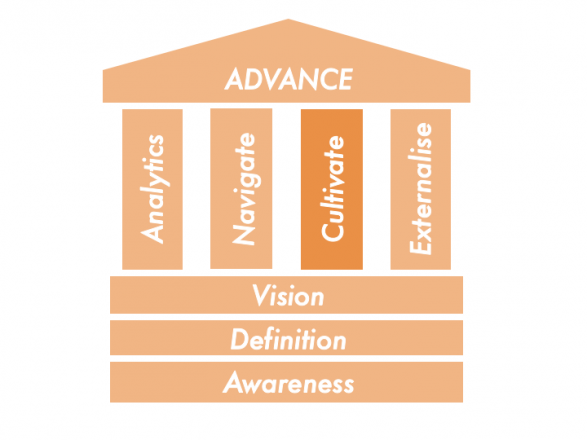
  • ADVANCE – cultivate your culture

    ADVANCE – cultivate your culture

    In agriculture, cultivate  makes us think of preparing the soil for planting and tending to crops. When we cultivate we improve something; we foster growth, perhaps by focusing on a particular situation, person or characteristic.

    To achieve change that lasts, we are going to have to cultivate those around us (and probably ourselves at the same time). ADVANCE requires us to use data to improve the quality of the decisions we make.

    But we can’t rely on the decision-making of one leader, as there is insufficient capacity and capability to undertake the busy operations of a department or institution.

    We also know that the academic environment is full of people with a leadership mindset; they want to lead or be led; they don’t warm to directive management.

    We therefore need to build a culture that increases leadership capacity, so that more individuals are empowered to take the initiative, but also to ensure that they take initiatives that will move the department forward, not strangle it with uncoordinated conflict.

    We don’t necessarily have to create new processes every time we want to initiate change. Some managers do this and create longer term problems for themselves.

    Often it’s best to make better use of the existing systems and processes; you might use them in different ways, or increase the value of them. But the key is to save any disruption for specific obstacles.

    Culture change, and the processes of cultivating a different group mindset are complex topics. We are not going to address this complexity in its entirety in one article.

    However, we are going to explore a fundamental instrument of most organisations – the annual staff appraisal – and examine how a coaching mindset, combined with rational data from the environment, can significantly accelerate your ability to cultivate positive change.

    Annual appraisals

    The annual staff appraisal can strike dread/apathy/excitement/disappointment into all parties. In many cases, staff may feel that they will have to defend what they have done, or at least make an argument to counter what their manager expects from them.

    There is a tension between coaching as a developmental activity, and appraisal, which is something that a coaching manager must navigate carefully.

    Managers might want to use appraisal processes and documentation for the purposes of ‘transparency’ – where everyone appears to be set common objectives that can be easily reported on. Inevitably, with such a situation it is difficult to get all staff to play to their strengths. We are all different, and have something unique to offer.

    Managers are also being ‘managed’, and therefore they are likely to be required to report when all of their staff appraisals have been completed (are all the forms completed correctly and filed with HR?).

    If you have a few appraisals left to do, and they should have been completed earlier, there may be an implicit pressure to ‘get the paperwork done’, rather than fully take advantage of a developmental conversation with a member of staff.

    In a university setting there is the additional challenge of working with academic staff. As academics we like to argue and debate; we like to understand what something really means, and feel that we can relate to the context upon which a measure might be applied.

    We don’t have a problem with qualitative measures, but the fact that we are comfortable with the fact that we don’t have an answer readily available, doesn’t necessary help the organisation progress.

    But academic life can be a relatively selfish pursuit, and if we are thinking, we are learning. As we have explored earlier in this book, academic staff in general respond less enthusiastically to directive management styles, hence our advocacy of the manager as a coach.

    But as leaders we should attempt to focus upon activities that deliver value. What is the point of maintaining a dysfunctional approach to staff appraisals, if the mere thought of it saps the life out of us?

    However, if you think that you can just dispense with appraisals, then good luck. It would be a bold move to counter the generally accepted wisdom of a large bureaucracy, that has policies for staff appraisals, even though most of the managers see it for what it is.

    Of course as leaders we shall tap into our optimism and explore a more positive approach.

    Reflection: Reflect upon the conversations that you have had with staff in relation to their performance at appraisal time. Now compare this with your daily conversations. What differences do you observe? How can you transform the annual appraisal conversation with a member of staff?

    Perhaps the first issue to tackle is that the appraisal might typically be an annual conversation, and therefore it is too detached from working life. So maybe the first thing to think about is how the annual appraisal can be coupled more directly into the daily conversations.

    How can daily dialogue contribute towards the annual appraisal?

    What departmental themes could link a staff member’s contribution into the departmental/institutional vision?

    If we are going to evaluate performance, what evidence would you expect a member of academic staff to provide?

    These questions are much easier to answer if we have a clear vision of what the department/institution will look like, which you will have as a result of the foundation stones of ADVANCE. You will have the confidence that not only is the vision based upon reason and fact, but you will also have involved the same staff who you are appraising during its construction.

    If, after all this they don’t know what the vision looks like, how can they translate you aspiration into their daily working lives?

    This should give you a clear idea of who falls into the ‘un-coach-able’ club. 

    As I said earlier, don’t waste energy coaching staff who aren’t receptive to open, challenging, developmental language. Invest in those who have potential, and those who are already performing at a high level.

    When you have developed your vision based upon facts that are relevant to your environment, the future is crystal clear. You will have identified the measures/metrics/characteristics that will indicate progress towards your vision. You can feel the future success!

    If a staff member can’t ‘feel’ the success, maybe they are a) in the wrong role, or b) in the wrong environment.

    You need to exercise some sensitivity in both of these cases. I feel that directive performance management can often ignore these two scenarios (or at least dismiss them, assuming that if someone is truly unhappy they’ll find another job), resulting in frustration for the manager and undue stress and anxiety for the staff (and their families, significant others, etc.).

    A coaching manager has to have the mindset whereby they truly want to help people. That includes people who don’t seem to be able to align themselves with the vision. Maybe they have been used to a way of being managed, and your approach is a surprise.

    Or they are actually quite fearful of change. Coaching can be quite effective in these situations, particularly if you commit to developing a relationship based on trust.

    They need to trust that you are genuinely interested in their workplace well-being. You can only build this trust by being optimistic, honest and generous with them. So, perhaps they are not quite ‘un-coach-able’ yet.

    Attendees at my workshops have echoed this sentiment many times; through a coaching oriented relationship they have helped a staff member either align themselves better with a department, or they have worked together to discover what the individual would prefer to do.

    When a staff member has a clear vision of what they want, a lot of the barriers disappear. Whilst this may result in the member staff leaving, their departure is because they have found something better for them.

    Don’t underestimate the strength of the message that this projects to the immediate environment. When staff leave of their own accord ‘for something better’, they leave on positive terms. The rest of the department will see this; they will already know that a particular individual would not align with the change initiative.

    But they also observe an academic manager who reinforced the belief that the staff should be valued, and that means helping them discover their own potential, through a role they are suited to.

    The coaching manager does not persecute staff and make them perform against their will.

    So, with your measures and vision to hand (which you repeat and make reference to at every opportunity), the daily conversations become easier. 

    It’s then a process of aligning individual staff capabilities with the departmental themes. It’s about identifying where staff development has to take place – and after a short while, your staff will start telling you what development they need to align with your vision.

    As a departmental culture develops, mindful of a clearly articulated vision, the annual appraisal becomes more straightforward. Staff will identify the evidence that is already in place as a result of them aligning themselves to the vision. The developmental conversations will already have started during the year, and will be regarded as continual.

    The appraisal will suddenly have found its place – a chance to review progress over an extended period, and an opportunity to think a year or two ahead, as well as to discuss individual staff aspirations. Therefore, the appraisal will have morphed into something that is more developmental. 

    And this is at the heart of being able to cultivate a culture that wants to continually perform at a higher level.

    OK you say, this is all well and good. But at the outset there are staff who will find this approach challenging, and they will make the process arduous. Surely this will bring the whole culture change to a halt?

    It is common for the first round of appraisals to be difficult. There will be a minority that welcome the change in approach, fully subscribing to the notion that they can take charge of their own development in the context of improving the department.

    There will be a significant portion that are wary, suspicious, and genuinely frightened that they can’t measure up to the vision. Some of them will display apathy (“I’ve seen this before; just sit tight until the next initiative”), some will retreat and become reclusive, and some will generate a veil of enthusiasm, and produce a shopping list of expensive, time-consuming staff development activities.

    Beware, because the first request that you turn down could be used as an excuse to suggest that you never really meant what you said in the first place!

    And finally there is likely to be a hardcore minority who have every intention of not engaging. They may be frightened, confused, delusional, incompetent or just insecure. Every trick in the book will be used to dodge the process.

    Some managers see this as a game, with the objective of trying to ‘outwit’ their ‘opponents’. Unfortunately there are many examples of this approach being legitimised, in that the measured performance improves.

    Of course in such situations it is unlikely that a longer term vision has been created and it is the short-term transformation of numbers that is reported as a success. Nonetheless, the cost to the environmental culture can be quite damaging.

    As an academic coach you’ll persevere beyond the initial challenge as you’ll have  confidence in the long term view. The measures you will have chosen will be based on the data that you have reasoned is important.

    In time, some of the hardcore will come round and realise that it might be interesting to engage after all, especially since the manager seems to want to help staff.

    The second round of appraisals is where managers see the greatest transformation. The keen early adopters are already bearing fruits of their focused engagement, and doing things that are visible to the rest of the department.

    They’ll already be in a position to Externalise. Success in acquiring one or two small funded projects can do wonders for the self-confidence, motivation and external visibility of an academic, which of course you will be supportive of.

    While hard-liners will still be resisting, the rest of the department will have started shifting. They’ll have witnessed the successes of the early adopters, and some will have got themselves involved already.

    Others will test the water by suggesting some new activities that they would like some development for. Some will be bold enough to set themselves a target to achieve for the coming year.

    By the third appraisal the bulk of the changes will have been made. Staff will have discovered what they like doing, to what extent it can be accommodated (usually the department is more flexible than people think), and have witnessed the benefits to them personally, all wrapped up in a department that is performing better.

    If during this period your department has recruited new staff, then the transformation is accelerated significantly. The new starters come in fresh and adopt the developmental approach without being held back by any prior cultural baggage.

    What is important to remember that if you actively monitor and measure performance in a directive way, the annual appraisal will remain the key event on the calendar to report achievement.

    In contrast to this, a coaching-oriented style positively supports development on a continual basis, meaning that the annual ‘check-in’ can be more focused upon the strengthening of core values and the development of longer term career goals for an individual.

    So, you have it within your power to re-purpose the staff appraisal process and it’s an excellent instrument to cultivate higher performance.

    Reflection: What are the potential benefits of planning to develop role models in your environment? What can staff learn from a role model?

    Exercise

    A key tool of culture change is how you approach the appraisal and development of others. To do this you must familiarise yourself with the current staff appraisal process. Sometimes this is referred to as a ‘cycle’, or a ‘developmental review’ and there may be key points in the annual calendar at which point certain activities are undertaken.

    Once you have oversight of the process, look for ways in which your vision and measures can be incorporated into the cycle. For instance, do you have an event whereby a line manager discusses the objectives of the department for the coming academic year?

    As a coaching manager you are more likely to use this departmental objectives as prompts for developmental requirements for the individual concerned.

    If all staff need to produce two published outputs this year, what support will each of them need? Some will need more support than others.

    Depending upon your procedures for appraisal, you need to either rework the forms/processes etc., for your own purposes, or you should provide an addendum that enables the explicit links to be drawn between the departmental/institutional objectives, and the individual’s developmental requirements.

    The purpose of the addendum is to explicitly highlight the linkage between an individual’s contribution to the larger environment. This helps everybody by making clear what needs to happen, and prompts them to think about the support they need to help the department achieve its target.

    Developmental conversations that start with this tend to productive. Sometimes an individual will not feel able to respond; this is OK as well, as the process of helping them complete it is another fantastic coaching opportunity.

    If we look at some extracts from a developmental objective setting form (Tables 2 and 3), we can observe the link between departmental target, an indicator of what successful achievement looks like, a space for he individual’s contribution as to how they shall engage, and a date by when it needs to be concluded.

    This both prepares the groundwork and frames a coaching conversation in terms of the individual’s development. The key question for the individual is:

    “What development support do I need to achieve my objectives?”

    You might choose to add this to your form, to be completed as an outcome from your meeting. 

    Departmental target

    How will we know when this has been achieved?

    How will you provide evidence of your engagement?

    By when?

    Improve student satisfaction score across modules taught

    85% of the students will report ‘satisfied’ or ‘very satisfied’


    End of Semester

    Improve first-time pass rate

    80% of the students will pass first time and progress


    End of Semester

    Improve student achievement

    60% of students achieve at least 2:1 or First


    End of Semester

    Provide timely, constructive, written feedback to students

    100% of summative assessment feedback received within 4 weeks of submission deadline


    End of Semester

    Table 2. Extract from the teaching quality section of a development review form.

    Departmental target

    How will we know when this has been achieved?

    How will you provide evidence of your engagement?

    By when?

    Improve quality and volume of research output for the department

    Principal researcher: 6 peer-reviewed articles, >2*

    Researchers: 3 peer-reviewed articles, >2*

    Other staff: 1 peer-reviewed article, >2*


    End of year

    Improve the external esteem of the department

    Principal Researchers: 2 research events organised/edited books/edited journal special issues

    Researchers: 1 research event organised/edited books/edited journal special issues


    End of year

    Improve the research environment

    Principal Researchers: attract and supervise 1 new PhD student

    Researchers: attract and supervise 1 new PhD student


    End of year

    Increase research funding into the department

    Principal Researchers: achieve at least one successful bid >£150k as Principal Investigator

    Researchers: submit at least 2 applications for funding >£10k          Other staff: engage with at least 1 funding bid submission


    End of year

    Table 3. Extract from the research section of a development review form.

    Using the above as a guide, take the measures you identified in Definition and Vision, and create a document that can be used to augment your existing developmental review/appraisal documentation.

  • The manager as coach

    The manager as coach

    Coaching is a popular topic, particularly in the world of business. Executive leaders employ personal coaches to have developmental conversations, to explore hypothetical scenarios, and to encourage self-awareness. It follows that the practice has expanded, with many people deciding to make careers of coaching, as greater numbers of individuals use coaching services to improve their own development.

    One of the defining aspects of business/life/personal coaching is the absolute focus upon the processes of coaching. The coaching engagements are typically short term, perhaps six separate sessions for instance, and therefore there is a lot of emphasis on developing techniques to establish ‘rapport’ quickly between the client and the coach.

    Coaches that focus on helping clients solve their own challenges need not know anything about a particular business domain or industry; in fact the fresh perspective may be a significant advantage in terms of lateral thinking. In addition, each engagement is clearly identified – the session will be dedicated to coaching – with no chance of conversations being polluted by the most recent managerial crisis.

    Such coaches practice the skills of coaching conversation, using powerful questions to challenge and pursue potential barriers in the client’s thinking. The conversation may be augmented with specific tools that can help clients gain a new outlook on a situation.

    What these coaches don’t have therefore, is a line management responsibility for the client. In fact, they are employed by the client so there is a relationship of service. The coach is not required to appraise the client with a view to determining any actions other than to improve the client’s performance. Finally, the coach has a defined engagement with the client that is usually temporary in nature. Once the required development has been undertaken, the relationship ceases.

    In sharp contrast, the coaching manager has a line management responsibility for the coachee. They are required to appraise the coachee at least annually, and the outcome of that appraisal may be linked to career progression. In addition, the relationship normally is expected to be of a more significant length.

    With these characteristics in place, how does this affect the manager’s ability to coach?

    Reflection: Think beyond the use of open questions in your dialogue with staff. What difficulties might you envisage if you adopt a more developmental approach towards your staff?

    It’s important to realise that a coaching manager has to adopt a different outlook to a ‘pure’ coach. Coaching practice is different to having the responsibility for staff and operations. Tasks have to be completed on time and to the correct standard, in an efficient manner. There is bound to be directive language in the requisite conversations, otherwise the short term objectives might not be met.

    In terms of the annual appraisal, or any event where a manager has to evaluate the performance of a member of staff (which is more common in project-oriented environments), then there is a fundamental tension between making judgements and coaching.

    When we appraise staff, we are placing the focus upon the objectives of the organisation, rather than the needs of the individual. As we have discussed so far, whilst coaching could be the preferred way of supporting the development of individuals, it can only at best follow on from an appraisal.

    The fact that an appraisal conversation can be less conducive to coaching, means that the coaching manager would be wise to clearly identify the context of the discussion up front. So, be clear when you are making organisational judgements based on the needs of the institution, and be clear when you are coaching.

    Developing a coaching mindset

    The decision to coach is relatively easy to make. There are simple practices that can be adopted such as asking open questions and ‘active listening’ that can yield a lot of value. As managers in challenging environments we can forget that we are immersed in the present and consumed by tasks that need completing. The time to pause and reflect can disappear and therefore our opportunities to learn are diminished.

    However, adopting simple changes in behaviour does not in itself result in a coaching mindset. Some extra value will be obtained, but ultimately there is a limit to what can be achieved by listening and questioning as a line manager. Remember, the pure coach does not have direct responsibility for your own development; they merely help you identify the need for it.

    As a coaching manager you must truly want to help people. Managers who see their staff as instruments for their own advancement will struggle with developmental coaching. They’ll adopt some techniques that make them perform better in the long run than a directive manager, but the real power of coaching will not be realised. 

    Where some managers can go wrong is that they want to help staff, but their help actually constitutes advice and directive instruction.

    Every time you use a directive approach towards your staff, you are inhibiting the opportunities for them to think for themselves and possibly solve the problem in the future, without bothering you!

    Managers that adopt a coaching mindset tend to look within themselves and use the coaching of others to increase not only the coachee’s self awareness, but that of their own. They will serve their staff by genuinely supporting their development, and they will strive to be helpful rather than evaluative. Along the way, a coaching manager will develop an individual coaching identity, that will be based upon their own personal values.

    Reflection: In your current context, what will be possible as a result of you adopting a coaching mindset?

    The ‘un-coach-ables’

    There is one further difference between personal coaching and the practice of the coaching manager. Executives hire coaches out of choice. They are wanting help with something and the coach is brought in to assist.

    Imagine the scenario where you are introduced to a coach upon the recommendation of your line manager. In fact, your line manager has read about the benefits of coaching and feels that you will be able to perform better after coaching.

    How enthusiastic are you likely to feel about this?

    This is an example that supports the perception that performance management is viewed as a remedial task, and that by association, coaching is similar as it is a method of improving an individual’s performance. This is problematic for two reasons.

    First, as we have discovered, coaching is related to learning. If the recipient doesn’t want to learn, they are unlikely to embrace coaching. This might not be a conscious decision on the part of the individual; they may not be sufficiently self-aware to recognise that their actions are creating challenges for others.

    Second, coaching is often deployed as means to ‘fix’ people. If there are specific weaknesses in an individual’s performance, it could be that the individual may not also be receptive to coaching.

    As a result, a considerable amount of time and effort is expended attempting to coach the ‘un-coach-ables’, rather than supporting able staff who are willing to grow.

    Coaching should not be viewed as a panacea. The coaching manager will achieve far more by concentrating coaching upon receptive staff, so that their talents and abilities can be realised. In the longer term, our fostering of a coaching culture will create an environment whereby those who have been coached will adopt the necessary mindset to coach others, resulting in a reduction of the impact of individual poor performance upon the performance of the collective.

    Exercise

    Reflect back over the conversations you have had over the past working week.

    • What proportion of these discussions did you provide advice?
    • What were your reasons for providing advice?
    • What were your reasons for asking questions?
    • If your staff were less dependent upon your expertise, how would you spend your time?
  • Risky rapport

    Risky rapport

    I’m chatting with an academic colleague about student engagement. He is struggling with one particular class. The students turn up frequently enough to avoid triggering attendance monitoring processes, and it’s creating havoc in the group assessments.

    This is as frustrating for my colleague as it is for the students who resent having to carry peers who aren’t present.

    Like this sort of conversation.

    I can listen to a colleague, we can share ideas. We can explore and test wacky thoughts, and if we decide upon some actions to try, we set ourselves up for another good conversation.

    A lot of the time, academic staff talk about issues that are troubling them, only they cannot see a way forward. There is always the quality assurance procedure that prevents something, or the External Examiner “wouldn’t like it”, or the students might give bad feedback in the end of module review.

    There was a hint of this thinking emerging during my chat about student engagement. I had posed a question of my colleague suggesting that we might think about other ways of assessing the students’ learning.

    “But we can’t give them an assessment every week.” This was an interesting statement, as my colleague had both suggested an alternate method of assessment and ruled it out in one sentence.

    This made me reflect on an article I had written some years ago – “Risky Business” – where I described my experiments with curriculum creation on-the-fly with students. The semester’s plan consisted of some learning outcomes, an assessment rubric and twelve weeks of space; no session plans, lectures, worksheets or reading lists.

    At the end of the module, all of the above artefacts, that might normally constitute a module that is ready to run at the beginning of the semester, were in place. The key difference being that those on the module would create the content as a by-product of our shared learning.

    Almost ten years later, I have come to rely on this approach as my default position when it comes to teaching for the following reasons.

    First, I have joined the dark side of academia by becoming a manager, and my time is severely limited. I use this argument when I am discussing a lack of time to do other things such as scholarly activity, research, schools outreach, income generation, etc.

    Second, I have done it so many times now that I no longer regard it as “risky”. In fact it always produces more opportunities for variety of learning experience.

    Third, as Head of Department I have had to stand-in for colleagues at very short notice. As long as there are some module learning outcomes, I’ll be fine. Though it would be interesting to “up” the level of risk and see what we could do if we only had programme-level learning outcomes; we would then have to sort out our own module learning outcomes during the first session.

    Fourth, it works better, and more consistently than a curriculum that stifles creativity, but is administratively very organised. There is the flexibility for the students to collaboratively publish a book if they feel that it suits what they have to do.

    Or build some software. Or organise an event. Or build a user manual. Or compose some music (I haven’t done that one yet, but I’m open to the right cohort suggesting it).

    Finally, the approach helps me build deeper learning relationships with my students. They remember what they did as it is novel, and they usually enjoy what they have produced. They are absolutely clear that not only have they learned something, they took an active part in the debate, selection, design and realisation of their outcomes.

    Whilst this all sounds fantastic, it is not always enough to sell the approach to staff that have got used to teaching in a particular way. In an era where academics are having to take notice of external measures, it is all too tempting not to rock the boat. In my conversations with academics, it is more a fear of the potential repercussions of taking risks with learning that  prevents innovative progress to be made.

    I reassure staff that the repercussions are often unfounded, and usually, can be easily mitigated. If you are frightened that the students might not actually come up with something useful to do in a session, it is prudent to have some ready-made exercises up your sleeve for immediate delivery.

    But I have found that the occasional “emptiness” in a session is akin to a silent pause in a speech; the atmosphere changes, people become more serious and they listen more intently. Don’t underestimate a group of students who can see that they should be doing something productive with their session. I’ve stopped under-estimating them and they are just fine!

    I do feel that I have discovered the ultimate mitigation strategy though. It comes down to good rapport. The sooner that rapport is developed with the cohort, the sooner they will trust the tutor and get on with the business of learning. We want them to own their sessions, rather than passively attend a delivery event.

    And so back to my colleague’s conversation. I’ve done the sales pitch for ripping the curriculum plan up. I’ve presented the compelling case for empowering the learners. I’ve also sprinkled the chatter with reminders of how much fun can be had running sessions where we are all actively learning.

    There is still nervousness, though the potential is quite exciting. How can this be overcome?

    One strategy could be to adopt a small risk, a small variation in delivery, and then incrementally build upon it until the innovative curriculum  emerges. I’ve tried this and it didn’t quite work for me. The piecemeal approach meant that there was no real risk being presented, and therefore little to be gained. I had to commit to something radical, as that was where the rewards lay.

    My support therefore has moved on from being a sounding-board, to coaching innovation. My words are there to support a colleague who has to jump right in and feel the energy of emergent and reactive behaviour.

    Which makes sense really. If we want the learners to take risks, we have to take the lead.

  • What is performance management?

    What is performance management?

    I think that it’s fair to say that if you hear `performance management’ in an academic context, then it is referring to a negative situation. People tend to be ‘performance managed’ when their behaviour or ability to perform a role is under question.

    The connotation is that staff from the Human Resource (HR) department will be involved, and that some formal processes will be underway. So, performance management can be perceived as something that is done to staff when they are not measuring up to a standard.

    Perhaps though, performance management should not be exclusive to dealing with situations of poor performance. It should reflect the approaches employed to manage performance at all levels, both good and not-so-good. 

    Reflection: How does this compare with your previous experience of performance management?

    Of course, some would argue that the role of a university is far too complex to boil down into a few quantitative measures, and any attempt to specify measures to be managed, will result in added tension when the monitoring systems are implemented.

    For instance, the breadth of activities that a university undertakes will inevitably lead to compromises being made. Maximising excellence in research has to be made at the expense of other activities.

    Such activities can differ between HEIs; the ability to maintain good student satisfaction scores, or the amount of industrial (‘third-stream’) income are likely suffer if the academic staff focus wholly upon high-quality journal articles.

    Conversely, an enterprising university may find that its entrepreneurial income generation may be constraining an ability to create new knowledge and solicit research council funding.

    And of course, a focus upon income generation through student tuition fees may create a culture that finds it difficult to relate to the wider benefits of engaging in research and scholarly activity.

    In all cases there are tensions that require sensitive management. We should remember though, that what might be a complex situation for a group of staff (such as a department), might actually be distilled down to something that is much more polarised for an individual member of staff. For instance, a department may strategically plan to change its income profile to increase the proportion of funded research.

    Whilst for a research active academic this could reinforce or amplify the tension between teaching and research duties, for a teaching oriented academic there may be no foreseeable change in their immediate future.

    Reflection: Think back to your last appraisal meeting with your line manager. What aspects of that discussion, in relation to your performance, were, or could be, counter-productive for you?

    Our understanding of performance management is shaped by our experiences of being managed in an academic context. It is not uncommon for first time academic line managers to be exasperated by annual appraisal discussions with academic staff.

    Some staff will enthusiastically discuss quantifiable targets for the year ahead, and offer an insightful commentary on their performance for the previous year.

    Others will appear noncommittal and defensive; they’ll describe their contribution as strong but argue that their work is necessarily complex and unable to be measured.

    Another academic may provide an outright objection to the whole process and provide the basis of ‘a difficult conversation’, and in some cases cite the measurement of performance as a contributor to poor personal well-being.

    The mixture of these discussions will vary depending upon the prevalent culture of the institution, but also the local culture within departments and teams. It is useful to consider how this culture might be fostered by the predominant approach to management in your environment.

    Directive or self-directed management?

    A directive approach to management typically exhibits the following characteristics:

    • Performance measures and goals and determined at all levels of the institution, and formulated by the senior leadership team;

    • Managers monitor the performance of individuals against local targets;

    • Your line manager makes it clear what has to be done, how it should be done and by when;

    • Performance is assessed in terms of how well the work was done;

    • Frequent use of initiatives/project working to achieve short term goals.

    In terms of the daily conversations, a directive manager would have a tendency to instruct:

    • “That’s the second year running that the assessment and feedback scores have been less than 60%. You need to investigate and report back with an action plan by next Tuesday.”

    • “Those application conversion figures don’t add up. Marketing don’t seem to be able to talk to Central Planning.”

    • “The Quality Lead won’t like this. Get support from Central Intelligence and Estates first, before you present a paper at the Committee meeting.”

    This style is motivated by outcomes and can be frequently encountered in academic support/administrative areas. It also occurs in academic areas to varying degrees.

    In contrast there is management that encourages staff to be self directed. 

    This can be characterised as:

    • The mission of the organisation is identified, with the declaration of long-term ambitions;

    • A series of stakeholder consultations are held to determine the strategic priorities;

    • Action plans are created that may include qualitative and vague outcomes;

    • Managers utilise measures to initiate discussions around enhancement;

    • Managers use the mission to reinforce what has to be achieved, and refer to assessments of values and behaviours as measures of progress;

    • Significant emphasis is placed upon the staff recruitment processes, to ensure that incoming staff are of an appropriate ‘fit’.

    The daily dialogue also reflects the increased focus upon the individual, rather than on a system or process:

    • “I’ve seen the assessment and feedback scores as well. What do you think is the cause?”

    • “The application figures seem to regularly have errors in them. What are the reasons for this happening?”

    • “I think we can see where this is heading. How would you tackle it?”

    A self-directed style of management encourages a greater alignment between the intrinsic motivation of an individual and the organisation, with less reliance upon the control and reporting of performance against short term objectives. Traditionally, this has typified the stereotypical academic environment, whereby academic staff are trusted to work to support the institution’s mission, rather than to perform in a coordinated way to achieve an end of year operating surplus.

    Managers that require specific objectives to be met in a short timeframe can find this situation particularly frustrating. However, the emerging competitive marketplace in HE has started to focus the minds of university executive leaders in such a way that HEIs are starting to adopt more directive styles of management. In the same way that managers can be frustrated with a department of self-directed academic staff, academics can also find directives and ‘managerialism’ problematic.

    Like most things in life it is a question of balance; where the balance lies is likely to be different for each institution. But the increased pressure to perform well both financially and in the published league tables, combined with the potentially destructive situation of failing to get the best out of academic staff, means that there is much to gain or lose depending upon the approaches we adopt as leaders.

    It’s important that we make sufficient effort to understand our environment so that we can devise the best approach. You might think that a book that advocates the use of data to achieve transformation might be heading down the road of directive management. But data is not always quantifiable in the sense of ratios or absolute numbers, and qualitative data is often a rich source of insight for the curious.

    If we are to be successful at managing performance, we have to appreciate what is worth measuring, what will motivate individuals, and how they respond to the local culture.

  • What is coaching?

    What is coaching?

    For a long time the practice of ‘coaching’ has been associated with sport, and more specifically it refers to a role whereby a ‘coach’ assists a ‘coachee’ to improve their competitive performance. The coach offers an external perspective of the coachee, and can utilise this  position to help diagnose inhibitors of improved performance.

    Over time the practice of coaching has become synonymous with enhancing performance in a much wider set of situations, such as business or personal coaching. If we consider ‘coach’ as a noun, we see that it refers to a carriage that transports people from one place to another. In the context of improving performance, coaching is a means of taking someone from one state and transporting them towards a different, enhanced state.

    It is common for senior business leaders to employ personal coaches. These coaches can observe their clients and offer an unbiased challenge that is free from organisational politics. The coach offers a confidential space for the executive to explore current challenges, and has a focused listener with which to work through potential solutions. As individuals face greater challenges in the workplace, and the focus of continuous, personal development becomes more pervasive, greater numbers of people outside of executive management are recruiting personal coaches.

    So what is coaching? At its heart, coaching can be as simple as one conversation. It is the type of conversation where two people interact where the focus is positive and centred on one of the parties only (the coachee). The other party (the coach) challenges the coachee in a way that makes them think deeper about their challenges, so that they can reflect afterwards, learn more about themselves, and develop their own solution.

    Coaching is not about instruction, nor is it about offering specific advice. It is about the use of language to challenge a coachee’s thinking processes in order to help them learn and develop. If the coaching mindset is developed, the single coaching conversation becomes a constant stream of conversations that encourages coachees to become more empowered in their actions, and to take the initiative more frequently. Using and practicing skills such as listening, questioning, reflection and feedback enables coaches to challenge their coaches to develop without explicitly directing them. This ‘non-directive’ approach is the basis of a coaching mindset.

    Having an awareness of coaching opens up an inordinate number of potential coaching conversations. You might be standing in a queue for coffee with someone; you could be seizing 30 seconds in a corridor; you might be using powerful questions in a team or departmental meeting; or you might have requested a formal meeting to explore a particular situation in a deeper way. All of these situations present opportunities to coach and therefore, these are all opportunities to enhance performance.

    The benefits don’t stop with the coach though. Those who adopt the coach mindset find that they become more influential in the workplace and they posses a better understanding of the workplace culture, but perhaps most importantly they learn a lot about themselves through the practice of coaching others. This enhanced self-awareness is powerful.

    So to summarise, a coaching conversation has the following characteristics:

    • The focus of the conversation is the learning and progress of an individual;
    • A coach uses ‘non-directive’ approaches by practicing listening, questioning and feedback skills;
    • The coachee will be challenged such that they reflect more deeply after the conversation and experience personal growth as a result.

    These characteristics have no bearing on the location or length of a conversation. Even an acknowledgement in the car park first thing in the morning, is an opportunity to coach!

    Why coaching for academia?

    So far, we have established a few things. First, the HE environment is changing into a competitive marketplace. Whilst the complexity of services that a university offers has not necessarily changed, the emphasis upon the achievement of short term outcomes is greater than has been traditionally the case.

    Second, the desire to be regarded as competitive has added weight to discussions around performance measurement and the management of performance. The complexity of most HEIs means that there have particular functions where performance has been actively monitored, but generally the concept of ‘performance management’ is seen as a remedial activity for staff that are incapable.

    Third, the effect of working towards longer term aims or ‘a mission’ has guided the evolution of cultures that can find short term objectives an irrelevance. As such, the focus of management has tended to favour people over processes for academic staff, in contrast with more directive styles for administrative/professional services staff.

    These three factors are not an exhaustive list, but they do give a flavour of the overall challenge. If universities are to change, our leadership needs to successfully chart a path that attempts to optimise the performance of the individual/team/organisation.

    Coaching and learning

    Universities are in the business of learning. Not as narrowly defined as a pure training organisation (although many HEIs sell training as part of their portfolio of offerings), but to sustainably provide education now and in the future, is a fundamental principle.

    As such, a HEI’s ‘core business’ is learning, whether it be through student tuition, research or industrial income generation. Another perspective is that organisations that are sustainable in the long term have to be able to adapt, and therefore have the capacity to learn; even the more modern HEIs have been established longer than a lot of private businesses. Certainly the traditional universities have substantial histories spanning several centuries.

    However, anyone who has worked in a HEI for a significant period will have witnessed the same mistakes repeated time after time. What does this say about the HEI as a learning organisation?

    Reflection: Remember a time when you foresaw a mistake being repeated. Write down the key characteristics of the weakness and describe the end result. What specific conditions need to change for the organisation to learn for the future?

    And so we return to coaching. At the heart of coaching is development, or learning. From earlier:

    “… coaching can be as simple as one conversation. It is the type of conversation where two people interact where the focus is positive and centred on one of the parties only (the coachee). The other party (the coach) challenges the coachee in a way that makes them think deeper about their challenges, so that they can reflect afterwards, learn more about themselves, and develop their own solution.”

    If the environment is conducive to coaching then it will be acceptable to approach your line manager to discuss your own performance, particularly because you want it to improve. You’ll do this knowing that your manager will genuinely want to support you without recording it as a deficit in your next appraisal. The conversation (or series of conversations) will challenge you to think, learn, and derive your own solution, which will increase your personal capability.

    From your line manager’s perspective there are some significant benefits of a coaching-friendly environment. First, staff that approach you with the expectation of a coaching conversation will reveal more to you about their overall interest for work. As a result you will understand them better, what motivates them, and what development they are seeking.

    Second, you will have a deeper understanding of what they can achieve and your trust in their capabilities will increase. You’ll know which activities they can complete successfully, but you’ll also have the confidence that their learning mindset will prevent them from repeating mistakes. In terms of performance monitoring you’ll have greater confidence in their abilities than looking at a spreadsheet of numbers.

    Third, staff who are self-directed demand less time from their managers. You’ll spend less time fixing every problem yourself and more time building an organisation that can adapt to environmental changes.

    Fourth, a coaching style of management reinforces the learner autonomy amongst staff. Whilst we can’t necessarily insulate every academic from short term objectives and management directives, a coaching culture can prevent the need to be directive for most of the time.

    Coaching language

    Since coaching utilises conversation, a fundamental part of successful coaching is our use of language. Coaching is about challenging conversations and therefore an important skill is building a repertoire of questions that will challenge a coachee sufficiently.

    One basic principle of coaching is to resist the asking of closed questions. Closed questions result in a ‘yes’ or ‘no’ answer. Here are some examples:

    • “Is there a way of improving the student attendance in your lectures?”
    • “Do you know why the applicant conversion rate has dropped?”
    • “Can you see that working?”
    • “Do you have any other options other than scaling the marks up?”

    The issue with closed questions is that the conversation is shut down there and then. All the recipient has to do is answer “yes” or “no”. Of course we would normally follow up with another question, but this results in an interrogation, which is one-sided against the coachee, rather than a conversation. So, let’s see what these closed questions might look like with some simple modifications:

    • “What can you do to improve the student attendance in your lectures?”
    • “What are the reasons for the applicant conversion rate dropping?”
    • “How can you see that working?”
    • “What options do you have?”

    The closed questions are now open. They set the scene for a range of answers, which the coachee is now challenged to explore. When you feel a closed question forming in your mind, rework it to commence with ‘what’ or ‘how’ and it won’t close the conversation down.

    This is a simple technique that can significantly increase the value of your interactions with staff. Using open questions means that the 30 second interaction in the corridor can now be part of a legitimate coaching approach. You can also start small – in the next committee meeting – and start to see the benefits without overtly advertising that you have recently read a book and changed your management style!

    Exercise

    Start immediately! Commit to using open questions in your next conversation and observe the results. For the first few interactions, record some notes afterwards about the essence of the conversation, the open question/s you used, and the results obtained.

    You may be surprised at the difference that coaching language can make.